

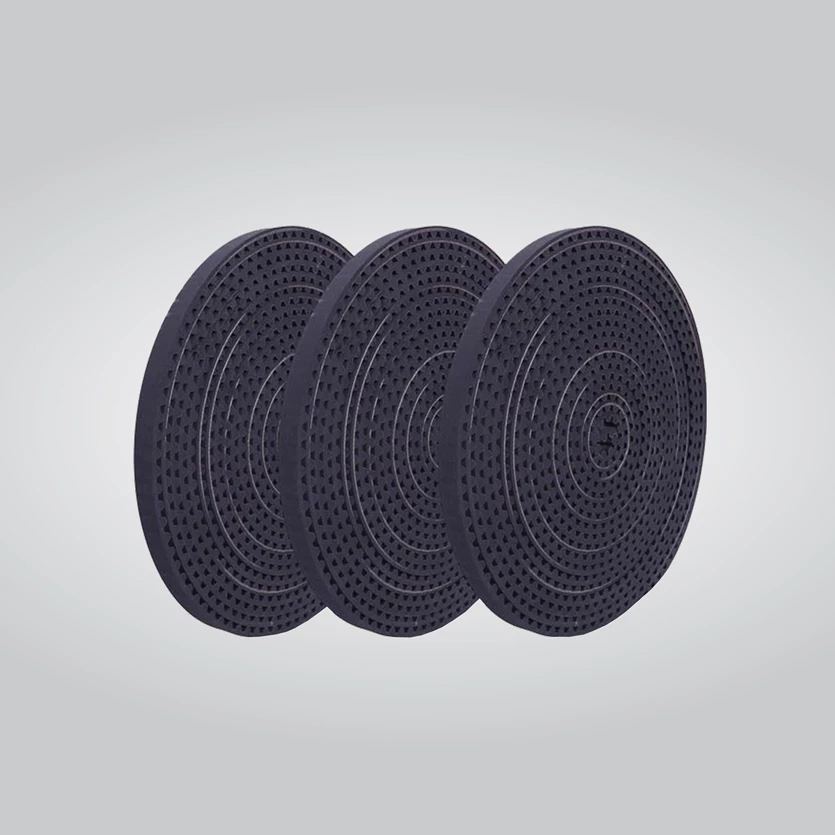
Open-Ended Rubber Timing Belts
Open-ended rubber timing belts are among the most important components in power transmission systems across various industries. These belts are produced in continuous strip form without a closed loop, and thanks to their flexible and durable structure, they are widely used in systems that require adjustable belt lengths.
Features of Open-Ended Rubber Timing Belts
• Adjustable Length: Can be cut to any desired size for use in a wide variety of motion systems.
• High Abrasion Resistance: Made from high-quality rubber, providing excellent resistance to wear and environmental factors.
• Precise Power Transmission: Specifically designed for systems requiring accurate motion synchronization.
• Design Flexibility: Can be combined with connecting clamps or other components for customized applications.
Applications of Open-Ended Rubber Timing Belts
• Automation and Robotics Systems: For precise motion control in robotic arms and automated transport systems.
• CNC Machinery: In the linear axes of precision cutting and engraving machines.
• Production and Assembly Lines: In material and component handling systems.
• Packaging and Printing Industries: For accurate control of paper, packaging films, and laminating equipment.
Open-ended rubber timing belts feature tensile cords made from fiberglass and are manufactured using a spiral cutting method from sleeves. These belts are commonly used in systems requiring adjustable lengths or linear motion. They also serve as an ideal alternative to chains or cables, offering high positioning accuracy in reversible motion transmission systems.
Belt Structure
• Backing: The belt backing protects the tensile cords and allows the use of idler pulleys.• Tensile Cords: Made from high-modulus fiberglass or steel cords.
• Body: Constructed from a special compound based on polychloroprene or EPDM rubber.
• Fabric Covering: Nylon fabric on the teeth is specially treated to enhance torque transmission capacity.