Textile Industry
Belts in the Textile Industry
The textile industry, with its complex processes and high demand for precision in producing fabrics, yarns, and finished products, relies heavily on specialized industrial belts. Power transmission belts, rubber and polyurethane timing belts, ribbed belts, V-belts, rapier belts, and heat-resistant mesh belts are among the most commonly used types in this sector. These belts enhance precision, speed, and production line durability, playing a key role in reducing costs and improving quality.
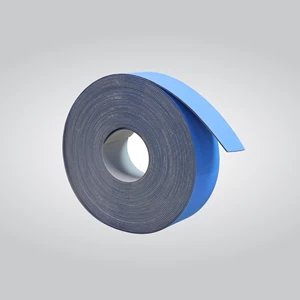
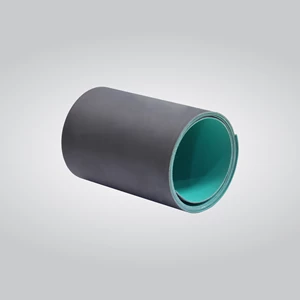
Flat Power Transmission Belts
Used for uniform power transmission to spindles and tension rollers. Thanks to their wide contact surface, high flexibility, and vibration reduction, these belts are ideal for maintaining constant speed and yarn quality. They are typically made from polyamide or polyester with fabric coatings to increase abrasion and heat resistance. Ravand Trans Apadana Company supplies genuine Nitta (Japan) and Habasit (Switzerland) belts, offering a diverse range of grades for various applications. Popular grades such as TFL15E20, TFL10S, TFL15S, and others are regularly stocked with exceptional quality. Features: Smooth surface, flexible, resistant to tension and abrasion. Applications: Transferring warp and weft yarns in traditional and modern weaving machines, such as air-jet or water-jet looms. Advantages: Uniform and slip-free motion, reduced yarn breakage, and maintained fabric quality.
Rubber Timing Belts
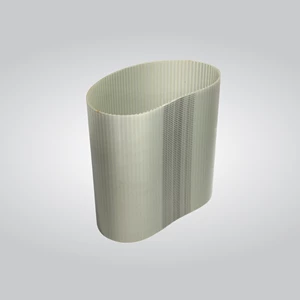
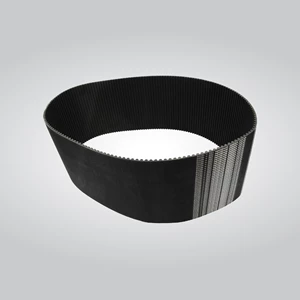
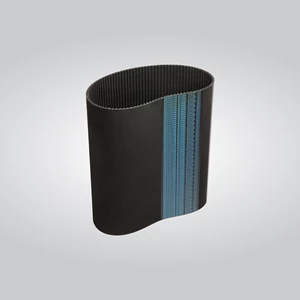
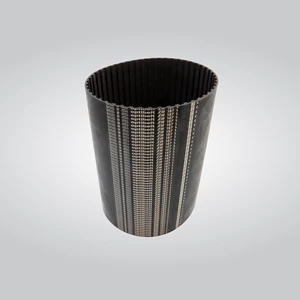
Various profiles such as 5M, 8M, H, and L are widely used in the textile industry. Ravand Trans Apadana Company supplies high-quality rubber timing belts for textile applications. Features: Toothed design, abrasion-resistant, high load capacity. Applications: In spinning and weaving machines for precise synchronization of moving parts, such as main shafts or yarn feeding systems. Advantages: High timing accuracy, reduced vibration, and extended machine life.
Polyurethane (PU) Timing Belts
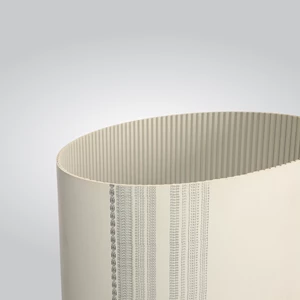
Profiles T5, AT5, T10, and AT10 are among the most important PU timing belt profiles with extensive use in the textile industry. Ravand Trans Apadana Company supplies them in high quality and various sizes. Features: Lightweight, resistant to chemicals and oil, flexible. Applications: In advanced textile machinery, such as shuttleless weaving machines or fabric printing systems. Advantages: Suitable for humid and chemical environments, with long service life.
Ribbed Belts
Available in profiles PJ, PK, PL, and PM, with extensive applications in the textile industry. Features: Multiple ribs for strong power transmission, anti-slip. Applications: In motors of heavy equipment such as spinning, weaving, or fabric finishing machines. Advantages: High power transmission without frequent adjustments, reduced energy consumption.
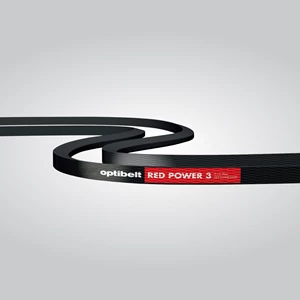
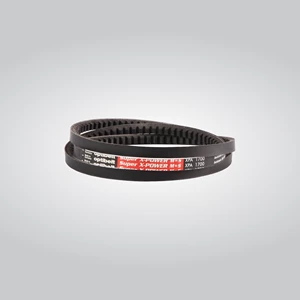
V-Belts
Classic profiles (smooth and toothed) such as A, B, C, and 9.5, as well as special narrow profiles (smooth and toothed) like SPZ and SPA, are widely used in this industry. Features: Trapezoidal cross-section, fiber-reinforced rubber, resistant to tension and heat. Applications: Power transmission in older and heavy textile machines such as carding or dyeing equipment. Advantages: High durability in harsh conditions and effective power transmission.
Rapier Belts
Rapier belts are a specialized type in the textile industry, specifically designed for rapier weaving machines. Due to their narrow structure, high tensile strength, and fast motion, they play a key role in modern weaving processes and are essential for producing high-quality and complex fabrics. Features: Narrow, resistant to tension and abrasion, designed for rapid movement. Applications: In rapier weaving machines for fast and precise weft insertion during weaving. Advantages: High speed and precision in weaving complex fabrics, reduced machine downtime.
Heat-Resistant Mesh Belts
These are industrial belts with a mesh structure designed for high-temperature and harsh conditions in the textile industry. They are typically made from materials like PTFE-coated fiberglass, aramid (e.g., Kevlar), or stainless steel, offering extensive applications due to their thermal and chemical resistance. Profiles/Features: Mesh structure with various opening sizes (1×1 mm to 4×4 mm), widths up to several meters, and thickness of 0.5 to 2 mm. Features:
- Heat resistance: Up to 150–260°C (for PTFE) and up to 600°C (for metal meshes).
- Chemical resistance: Resistant to acids, alkalis, oils, and dyeing chemicals.
- Non-stick surface: PTFE coating prevents adhesion of resins or dyes.
- Breathability: Mesh structure allows air and steam passage for rapid drying.
- Durability: High resistance to abrasion and tearing, suitable for continuous use.
Applications in the Textile Industry:
- Fabric dryers: In stenters or continuous dryers for drying fabrics after dyeing, printing, or washing.
- Fabric finishing processes: In heat-setting lines, lamination, or coating (e.g., waterproof or industrial fabrics).
- Heat tunnels: Transferring fabrics in ovens for color fixation, resins, or special coatings.
- Fabric printing: In continuous printing machines (e.g., silk screen or digital) for fabric transfer at high temperatures without deformation.
- Industrial fabric production: In processes for heavy fabrics like felt or composites.
Importance of Heat-Resistant Mesh Belts in the Textile Industry:
- Productivity: Enables fast and uniform fabric drying, increasing production speed.
- Product Quality: Non-stick surface prevents damage to delicate fabrics and maintains quality.
- Durability: Resistance to heat and chemicals reduces replacement and repair costs.
- Versatility: Suitable for diverse processes, from thin fabrics to heavy industrial textiles.
- Heat-resistant mesh belts